
Share:
1/72 versus 1/48: Which Model Scale Fits? (10.10.26)
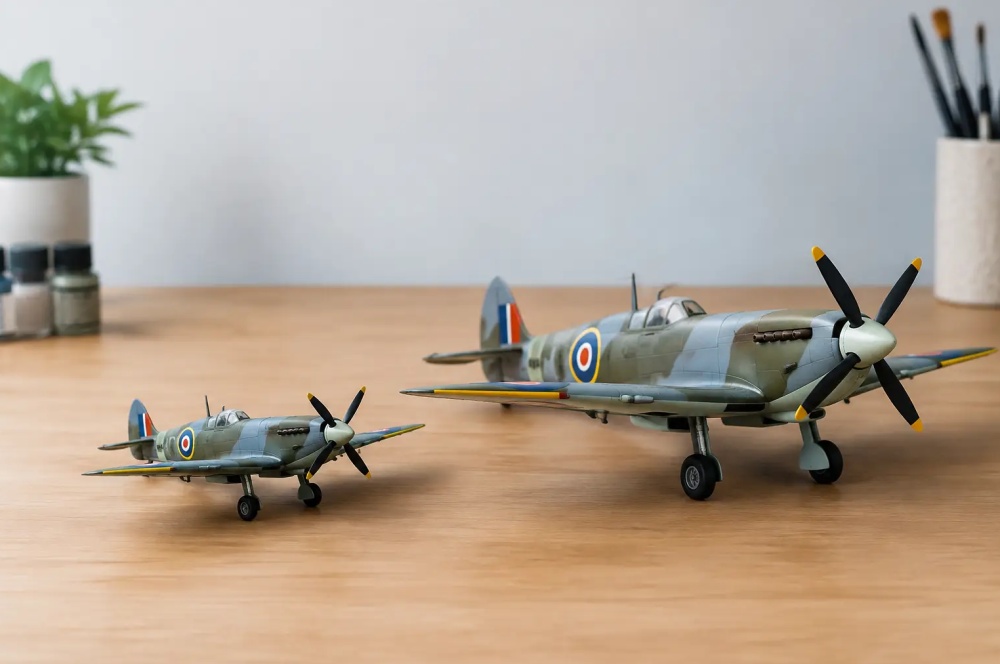
A 1/48 single-engine fighter can look modest in the box, then occupy most of a shelf once its landing gear, propeller, and open canopy are in place. Put several bombers beside it and the problem becomes obvious. The choice of 1/72 versus 1/48 is not simply about how much detail you can see. It determines what subjects you can build, how many projects you can display, which aftermarket items make sense, and how much time each model is likely to demand.
For aircraft builders, these are the two scales that most often compete for the same subject. Both have excellent kits, decals, resin accessories, masks, and photoetched upgrades available. Neither is automatically the better scale. The practical choice depends on the aircraft, your preferred level of finish, and the space available at your workbench and in your display case.
1/72 versus 1/48 at a Glance
The scale ratio tells you how many times smaller the model is than the real aircraft. In 1/72 scale, one inch on the model represents 72 inches on the real aircraft. In 1/48, one inch represents 48 inches. A 1/48 model is therefore 50 percent longer than the equivalent 1/72 model, while its overall volume and shelf presence increase much more dramatically.
Take a fighter with a real wingspan of about 36 feet. In 1/72, the span is roughly 6 inches. In 1/48, it becomes about 9 inches. That three-inch difference may sound minor until the model has a base, extended control surfaces, external stores, and a fragile antenna wire. With a large aircraft, the difference is decisive. A four-engine bomber that remains manageable in 1/72 can become a major display commitment in 1/48.
| Factor | 1/72 Scale | 1/48 Scale |
|---|---|---|
| Finished size | Compact | Noticeably larger |
| Surface and cockpit detail | Fine work required | Easier to see and enhance |
| Display capacity | Excellent for collections | Best for selected centerpiece models |
| Typical build pace | Often quicker, but not always | More parts and detailing potential |
| Large aircraft | Usually practical | Can require substantial room |
| Aftermarket approach | Decals and masks offer high value | Cockpit, wheel bay, and exterior upgrades are more visible |
When 1/72 Is the Better Buy
Choose 1/72 when the subject matters more than physical size, or when you want to build a coherent collection without turning every project into a space problem. It is particularly well suited to aircraft with large wingspans, multi-engine types, naval patrol aircraft, transport aircraft, and bombers. A display of related aircraft from one unit, campaign, or manufacturer is far easier to organize in this scale.
Smaller does not mean simplified. Modern 1/72 toolings can include sharply recessed panel lines, detailed wheel wells, well-designed cockpits, clear canopies, and finely molded ordnance. At normal display distance, a carefully painted 1/72 model has plenty of presence. The key is to spend effort where it remains visible: clean assembly, a convincing paint finish, readable markings, restrained weathering, and accurately finished landing gear.
The limits are real. Instrument panels, harnesses, cockpit sidewalls, and small antennas demand more care because the parts are physically tiny. Some photoetched accessories can be effective, but they may test both eyesight and patience. A resin cockpit can transform a basic kit, yet it is not always necessary if the canopy is closed or the kit already provides a good interior.
1/72 also makes financial sense for builders who prefer variety. The kit itself is often less expensive than the same subject in 1/48, and a collection can grow quickly. However, price varies significantly by manufacturer, tooling age, and subject popularity. A premium new-tool 1/72 kit with resin, decals, and masks can still cost more than a straightforward 1/48 release.
Best uses for 1/72
This scale is the practical choice for builders who want multiple variants, squadron lineups, historically connected aircraft, or large types that need to fit a standard cabinet. It also works very well for modelers who enjoy camouflage and markings work more than open-panel detailing.
When 1/48 Earns Its Space
1/48 is often the most satisfying scale for a single aircraft built as a focal point. The larger dimensions give the builder room to paint convincing cockpit details, add harnesses, wire landing gear, improve wheel wells, and make subtle weathering visible without exaggeration. It is large enough to reward close inspection while remaining more manageable than larger aircraft scales for most fighters and attack aircraft.
If you enjoy opening access panels, displaying an engine, folding wings, or loading a model with accurately painted stores, 1/48 provides a clear advantage. Individual parts are easier to handle, and the aftermarket ecosystem is extensive. Resin seats, exhausts, wheels, intake corrections, canopy masks, and decal sheets can all make a meaningful visual difference.
That visibility creates a trade-off. A larger model exposes mistakes more readily. Seams on an intake trunk, poor alignment on landing gear, thick paint around canopy frames, or uneven sanding will be easier to spot. More detail also creates more decisions. A 1/48 project can stay simple, but the scale tempts builders to keep adding upgrades until a weekend project becomes a long-term build.
Cost should be considered as a complete project, not just a box price. A high-quality 1/48 kit may need nothing beyond paint and basic supplies. On the other hand, an older kit can become expensive once you add a replacement cockpit, corrected wheels, masks, weapons, and decals. Buy the upgrades that address a visible weakness or support the specific version you intend to build.
Best uses for 1/48
Choose 1/48 for favorite aircraft, highly visible display models, subjects with attractive cockpit layouts, and builds where you want to use detailed aftermarket parts. It is also a strong choice when a particular kit offers better engineering or more accurate shapes than its 1/72 counterpart.
Detail Is Not Only a Matter of Scale
A common assumption is that 1/48 always produces a better model because it can hold more detail. It can hold more detail, but kit quality matters just as much. A recent, accurately engineered 1/72 kit may fit better and require less correction than an older 1/48 release. Better fit means fewer seams, less lost surface detail, and more time for painting.
Think about viewing distance as well. A model displayed behind glass is usually seen from several feet away. From that distance, correct proportions, clean paintwork, sharp decals, and a balanced finish matter more than an elaborate cockpit hidden under a closed canopy. Conversely, if the model will sit at eye level on an open shelf, the extra refinement possible in 1/48 may be worth the effort.
The subject itself can settle the question. A small World War II fighter in 1/72 is compact and elegant, but some builders find its cockpit and landing gear too delicate for their preferred style. The same aircraft in 1/48 gives more working room. A large jet or bomber reverses the equation: 1/72 often delivers the better balance between detail and practicality.
Plan the Whole Project Before Choosing a Scale
Before ordering, check the finished dimensions of the real aircraft and convert them roughly for both scales. Measure the shelf, not just the empty spot you can see. Allow room for a base, open doors, wingtip clearance, and safe handling. This is especially relevant when planning several models from the same unit or era.
Next, decide what you actually want to improve. Decals and canopy masks are useful in both scales because they affect highly visible areas. In 1/48, a resin seat or detailed exhaust may be a strong investment. In 1/72, replacement wheels, accurate stores, and a quality decal sheet can offer more visible value than filling every compartment with parts.
Also check scale compatibility carefully. Decals, masks, photoetched sets, resin conversions, and weapons must match not only the scale but often the exact kit family or airframe variant. A component labeled for one 1/48 release may not fit another manufacturer’s version. Modelimex organizes kits and aftermarket items by scale and subject, which makes it easier to compare the available options before committing to a project.
The Right Scale Is the One You Will Finish
There is no need to declare loyalty to one scale. Many experienced builders keep 1/72 for large aircraft and collection projects, while reserving 1/48 for personal favorites and detail-focused builds. That approach avoids forcing every subject into the same display and budget constraints.
Choose 1/72 when space, variety, and large aircraft lead the decision. Choose 1/48 when presence, visible detail, and a more involved build are the priority. Then select the kit with the best combination of accuracy, engineering, markings, and available accessories for the version you want. A well-planned project that reaches the display shelf will always be more rewarding than a larger kit chosen for detail alone.
(This article was created by AI)