
Share:
Photo Etched Parts for Models Explained (22.06.26)
A kit can look complete straight from the box, then fall apart under close inspection at the railings, seat belts, grilles, screens, and brackets. That is usually where photo etched parts for models make the biggest difference. They replace thick plastic with thinner, sharper metal detail, and for many builders that is the point where a good build starts to look convincingly scale.
Photo etch is not automatically the right answer for every project, though. Some sets transform a kit. Some add detail you will barely see once the model is closed up. Some are designed for straightforward upgrades, while others assume you are ready to fold tiny parts, remove molded detail, and adjust the kit to accept metal replacements. Knowing which is which saves time, money, and frustration.
What photo etched parts for models actually do
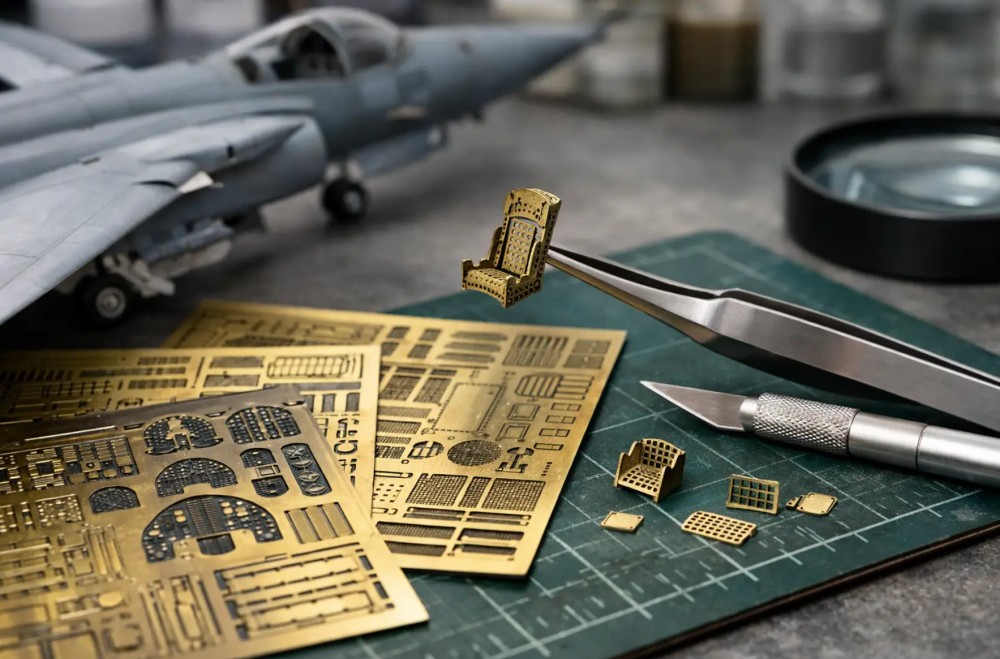
Photo etched parts are thin metal components, usually brass or steel, chemically etched from a sheet. Because the material starts very thin, manufacturers can reproduce details that injected plastic often cannot handle cleanly at smaller scales. The result is crisper vents, finer cockpit consoles, more convincing harnesses, thinner ship railings, scale-thickness fenders, tool clamps, and mesh screens.
The real advantage is scale appearance. On aircraft, instrument panels and seat belts benefit immediately. On armor, engine grilles, clasps, mudguards, and storage brackets often look better in metal than in plastic. On ships, railings, ladders, radars, and catapults are where photo etch becomes almost standard for anyone chasing a more accurate finish. Car modelers see the same benefit with grilles, badges, and fine trim.
That said, thin metal is not magic. It can improve scale fidelity, but it can also make a build more demanding. A part that looks better in brass may be harder to align, easier to bend accidentally, and less forgiving during assembly than the original kit piece.
When photo etched parts for models are worth buying
The best reason to add photo etch is simple: the kit has visible areas where plastic thickness or molding limits are obvious. If the cockpit is open, the engine deck is exposed, or the ship superstructure is covered in railings, the upgrade is usually easy to justify. You see the difference right away.
Scale matters too. In 1/72 aircraft, seat belts, panels, and antenna details can sharpen a small cockpit without taking over the whole build. In 1/48 and 1/32, photo etch can push interior and exterior detail much further, but it also invites more complexity. In 1/350 ships, many builders consider railings and radar arrays nearly essential if the goal is a refined display model. In armor scales like 1/35, mesh, tool brackets, and fenders are common choices because they correct areas plastic often renders too heavy.
It is also worth buying when the set is targeted to a specific kit rather than a broad subject. Exact-fit sets generally reduce guesswork. The more generic the set, the more likely you are to trim, adapt, or compromise.
The weaker reason to buy photo etch is simply because it exists. Some upgrade sets are extensive but bring only marginal visual gain unless the viewer is inspecting the model from a few inches away. If the model will be buttoned up, weathered heavily, or built as a quick project, a smaller set may be the smarter choice.
How to choose the right set
Start with the subject, scale, and exact kit number. That sounds obvious, but it is where mistakes happen. One manufacturer may release multiple boxings of the same subject, and aftermarket fit can vary between toolings. A set made for one 1/48 Bf 109 kit is not automatically correct for another. The same applies to armor kits with different hull details or ship kits from different production eras.
After that, look at the type of set. A basic set usually focuses on visible essentials such as belts, panels, grilles, or railings. A full detail set may include dozens or hundreds of parts for interior and exterior areas. Pre-painted sets can save time in cockpits and instrument panels, while plain brass gives more flexibility if you prefer your own paint and finish.
It also helps to judge the set against your normal building style. If you enjoy correcting and refining, a large set can be rewarding. If you mainly want one or two problem areas fixed, smaller targeted sets are often better value. Many experienced builders have learned that using selected photo etch is often more effective than loading a model with every available aftermarket item.
The trade-off: better detail, slower build
Photo etch adds precision, but it also changes the pace of the project. Plastic parts can usually be cut, cleaned up, and glued with some tolerance. Metal parts are less forgiving. You may need to remove molded-on detail first, fold parts to shape, test fit repeatedly, and attach with cyanoacrylate or another suitable adhesive.
This is why beginner and advanced sets should not be treated the same way. A simple aircraft belt set or an armor grille set is manageable for many modelers with basic tools. A large naval set with layered radar arrays, ladders, cranes, and railings is a different commitment. The challenge is not just attachment. It is consistency. One crooked railing on a 1/350 ship can pull the eye immediately.
There is also a realism trade-off. Some parts look more accurate in theory but less convincing in practice if left too flat. Seat belts, for example, often need careful shaping so they drape naturally. Flat brass handles may need extra work to avoid a two-dimensional look. In other words, photo etch improves potential, not results by itself.
Tools and handling that matter
You do not need a large workshop to use photo etch well, but a few tools make a real difference. A sharp hobby knife, fine tweezers, a hard cutting surface, a bending tool or smooth pliers, and magnification are practical basics. Good lighting matters as much as any of them.
Part removal needs care. Twisting pieces off the fret is a fast way to bend or launch them into the carpet. Clean cuts close to the attachment point are safer, followed by light cleanup. Folding should be deliberate rather than forced, especially on long or narrow parts that can distort easily.
Adhesive choice depends on the part and location. Thin cyanoacrylate works for many applications, but too much glue will spoil fine detail fast. Some builders prefer gel formulas for control on larger parts. For painted or pre-finished surfaces, handling becomes even more important because cleanup options are limited.
Where different subjects benefit most
Aircraft builders usually see the biggest return in cockpits, harnesses, airbrakes, gear bay details, intake screens, and exterior access panels. Not every aircraft kit needs all of these, but open canopy builds often justify a dedicated cockpit set.
Armor modelers tend to gain most from engine meshes, fenders, tool clamps, stowage brackets, and thin protective plates. These are areas where molded plastic can look overscale, especially on older kits. Some parts, however, may be so small and repetitive that the effort only makes sense if you enjoy that kind of detailing.
Ship modelers often get the clearest overall upgrade from photo etch because railings, ladders, radars, cranes, and platforms define the look of the subject. On many ship builds, these parts are not minor extras. They shape the entire finish.
Car and truck builders usually focus on grilles, emblems, harness hardware, brake details, and trim. Here the benefit is often selective rather than comprehensive, but the right metal details can sharpen a display build noticeably.
Buying with fewer mistakes
The practical approach is to match the set to the project, not the other way around. Check scale first, then kit compatibility, then the scope of the upgrade. If you are already buying decals, masks, resin, or conversion parts, think about the order of work as well. A highly detailed cockpit set may affect painting sequence. Exterior photo etch may change how early you can handle the model during construction.
This is where a specialist retailer with a deep catalog is useful. When categories are organized by subject, scale, and manufacturer, it becomes easier to compare a basic set against a full detail set and avoid buying duplicate or conflicting upgrades. For builders sourcing across aircraft, armor, ships, cars, and figures, that kind of range matters. MODELIMEX has long worked in that specialist space, where the difference between a useful accessory and the wrong one often comes down to exact kit fit.
Photo etched parts are best treated as a precision upgrade, not a mandatory step. Used well, they sharpen the areas that viewers notice first and bring a model closer to true scale appearance. Used without a plan, they can slow a project for detail that barely shows. The best builds usually come from choosing the few metal parts that solve the right problems, then letting the rest of the model do its job.
(This article was created by AI)