
Share:
Resin Conversion Sets for Kits Explained (23.06.26)
A standard kit can get you to the common production version. If you want the early nose, the export turret, the reconnaissance camera bay, or the field-modified engine deck, resin conversion sets for kits are often the only practical route. For many experienced builders, they are not impulse items. They are targeted purchases made to turn a familiar tooling into a specific subject that the base manufacturer never released.
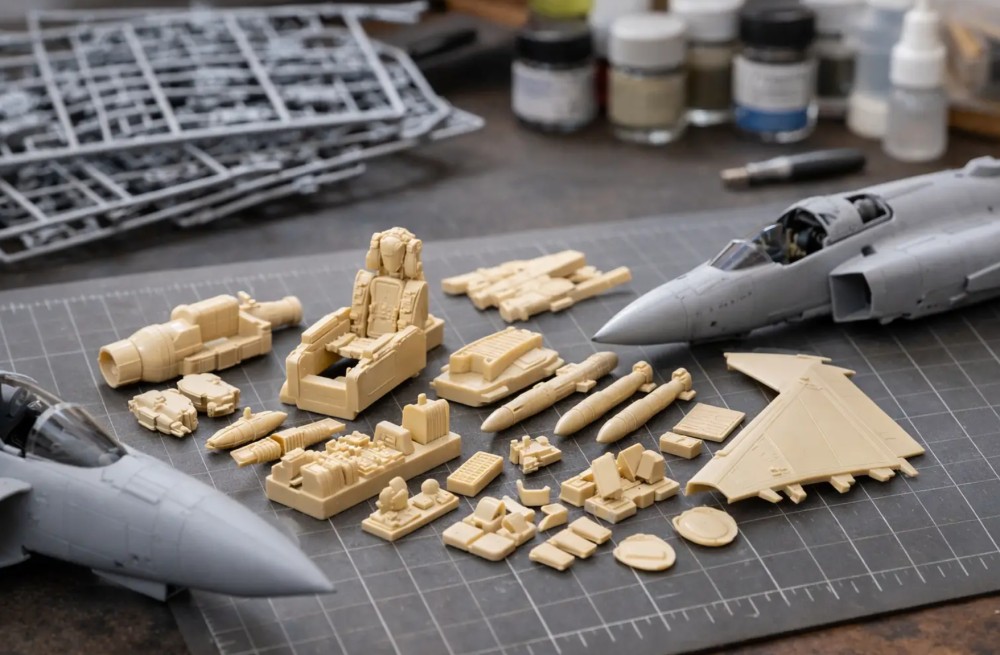
That difference matters. A conversion set is not the same as a simple detail set. Cockpit upgrades, wheels, seats, gun barrels, and exhausts usually improve what is already in the box. A conversion changes the subject itself. It may replace a fuselage section, a turret, a hull top, a wing, or an entire nose assembly. In some cases it adds enough major parts that the original kit becomes more of a donor than a complete model.
What resin conversion sets for kits actually do
At the practical level, resin conversion sets for kits let you build a version that the original tooling does not cover. Aircraft builders see this often with reconnaissance, trainer, night fighter, or early-production variants. Armor modelers run into the same thing with command vehicles, recovery versions, alternate turrets, and local modifications. Ship and figure builders use conversions too, though aircraft and armor remain the most common categories.
The appeal is straightforward. You keep the base kit's core engineering, scale, and surface layout, then replace the sections that define the variant. If the conversion is well designed, it saves a lot of scratchbuilding time while producing shapes that would be difficult to make by hand. If the conversion is poorly matched to the donor kit, however, it can create more work than it removes.
That is why compatibility matters more here than with most aftermarket items. A decal sheet can often serve several kits. A resin conversion usually cannot.
Start with the donor kit, not the resin set
Experienced builders usually shop for the donor kit and the conversion together, even if they already own one of them. That approach avoids the most common mistake: buying a conversion for the wrong tooling generation.
A resin nose designed around one 1/48 kit may not fit another 1/48 kit of the same subject. Panel lines can differ, fuselage cross-sections can be slightly off, and wing roots may sit at a different angle. Even when the scale and subject match on paper, the actual fit can vary enough to turn a clean project into a corrective rebuild.
The safest way to evaluate a conversion is to look for three things. First, the exact donor kit reference. Second, the variant covered by the set. Third, the extent of surgery required. Some sets ask for one straight cut on the fuselage. Others require removing multiple sections, rebuilding interior supports, or blending large resin parts into thin kit plastic.
If that information is missing, treat the set as advanced aftermarket, not a guaranteed fit item.
Why exact kit match matters
Tooling age plays a big role. Older kits may have heavier plastic, softer detail, and simpler internal structure. Newer kits may use more complex part breakdown, alignment tabs, and tighter tolerances. A conversion designed for one style does not automatically adapt to the other.
This is especially true in scales like 1/72 and 1/48, where many subjects exist in multiple toolings from different eras. In 1/32, the parts are larger and easier to manipulate, but replacement sections are also heavier and can put more stress on joins. In armor kits, hull geometry and turret ring dimensions are constant problem areas. In aircraft kits, fuselage width and wing root contour are usually where fit is won or lost.
What to check before you buy
The most useful product information is rarely the marketing headline. Builders should focus on material scope, donor kit reference, and visible casting quality.
Look at how much of the kit will actually be replaced. A small sensor fairing and a new tail are one kind of project. A full forward fuselage, cockpit tub, and canopy conversion are another. Both may be sold as conversion sets, but they do not demand the same time or skill.
Casting quality is just as important. Crisp recessed detail, thin casting blocks where sensible, and clean mating surfaces are good signs. Large pour stubs, soft edges, or warped long parts mean extra correction before assembly even starts. Resin is workable, but it is not forgiving if you expected a quick upgrade.
You should also check whether the set assumes other aftermarket. Some conversions really need photoetched details, vac canopies, decals for the specific variant, or corrected landing gear to finish properly. A conversion can solve the major shape issue but still leave you searching for the markings and smaller details that make the subject believable.
The trade-off between rarity and effort
The more obscure the subject, the more likely the conversion will demand compromise. Rare variants are exactly why resin exists in the aftermarket, but niche subjects sometimes come with shorter production runs, older masters, or less complete instructions.
That does not make them poor products. It simply means expectations should match the subject. If you want a mainstream, modern, low-risk build, a dedicated injection kit is usually easier. If you want the unusual version that nobody tooled in plastic, resin is often the correct answer.
Building with resin conversion sets for kits
Preparation decides whether a resin conversion feels precise or frustrating. Dry fitting is not optional. Before glue touches anything, test every major join, mark your cut lines, and compare left and right symmetry where applicable. Resin parts can look accurate on the bench but still need sanding and shimming to sit correctly on the donor kit.
Washing the resin parts is also standard practice. Mold release residue can affect paint and glue adhesion. Builders working with cyanoacrylate or epoxy already know this, but it is still one of the easiest problems to prevent.
Cutting the donor kit requires patience. Measure twice, cut once sounds basic, but a conversion often gives you only one clean chance to establish the joint. Use a fine saw, keep the cut square, and leave extra material if the fit is uncertain. It is far easier to remove more plastic than to rebuild what was cut too short.
Support inside the fuselage or hull can help a lot. Tabs, strips, or simple braces give the resin section more surface area and improve alignment. This is particularly useful when replacing large aircraft noses, tail sections, or armored hull panels.
Weight, balance, and strength
Large resin parts change how a model behaves. Aircraft conversions can turn a balanced kit into a nose-sitter or add enough forward mass to stress landing gear. Armor conversions may increase turret weight and affect how securely the assembly sits on the ring. Reinforcement is not glamorous, but it saves trouble later.
Think ahead about the finished model, not just the assembly stage. White metal gear, brass pins, or internal braces can be sensible if the conversion adds substantial mass. The larger the scale, the more this matters.
When a conversion set is worth it
A resin conversion earns its place when it gives you a subject you cannot otherwise build without extensive scratch work. It is also worth it when the variant has distinct visual identity and historical interest. An unusual spine, radar fit, command antenna layout, or reworked turret can turn a common kit into a specific machine with a clear story.
Price matters, of course. By the time you add the donor kit, resin set, decals, and possible supporting accessories, the project can cost more than a premium new-tool kit. That is not automatically a bad value. For many hobbyists, accuracy and subject choice matter more than the lowest total cost. Still, it is smart to view the full project cost before committing.
Availability is another real factor. Specialist retailers with deep aftermarket coverage make these projects much easier to plan because builders can source the conversion, decals, masks, and related items in one place instead of piecing them together across multiple shops. For modelers already searching by exact scale, variant, and manufacturer, that kind of organized stock depth is practical rather than decorative.
Who should buy them and who should wait
Intermediate and advanced builders get the most from conversion sets because they already expect test fitting, filling, sanding, and occasional corrective work. They can judge whether a set solves a problem or creates three new ones.
That said, not every resin conversion is an expert-only item. Some are surprisingly direct, especially when the donor kit match is exact and the replacement is limited to a single external section. If you are moving into resin for the first time, start there. Pick a conversion with clear instructions, modest surgery, and good documentation of the real subject.
If your goal is simply better detail on a standard variant, buy a detail set instead. If your goal is a different aircraft block, vehicle subtype, or mission-specific version, then a conversion is the right tool.
The best resin projects usually begin with a clear subject in mind, not with a random aftermarket purchase. Once you know exactly what you want to build, the right conversion set stops being a gamble and becomes a very efficient way to get there.
(This article was created by AI)